MaxClaw by MiniMax: The Cloud AI Agent Redefining Deployment in 2026
In 2026, the bottleneck of AI adoption is no longer the model — it's the infrastructure. Setting up a personal AI agent used to mean renting a VPS, fighting with Docker, and babysitting uptime at 3 AM. According to early adopters across the developer community, that era is now over. As SitePoint noted in their coverage, AI agent development has shifted from "can we build it?" to "how fast can we deploy it?" (Source: SitePoint, Feb 2026).
MaxClaw, launched by MiniMax on February 25, 2026, is making the most direct play yet for that deployment gap — and it's worth a close look.
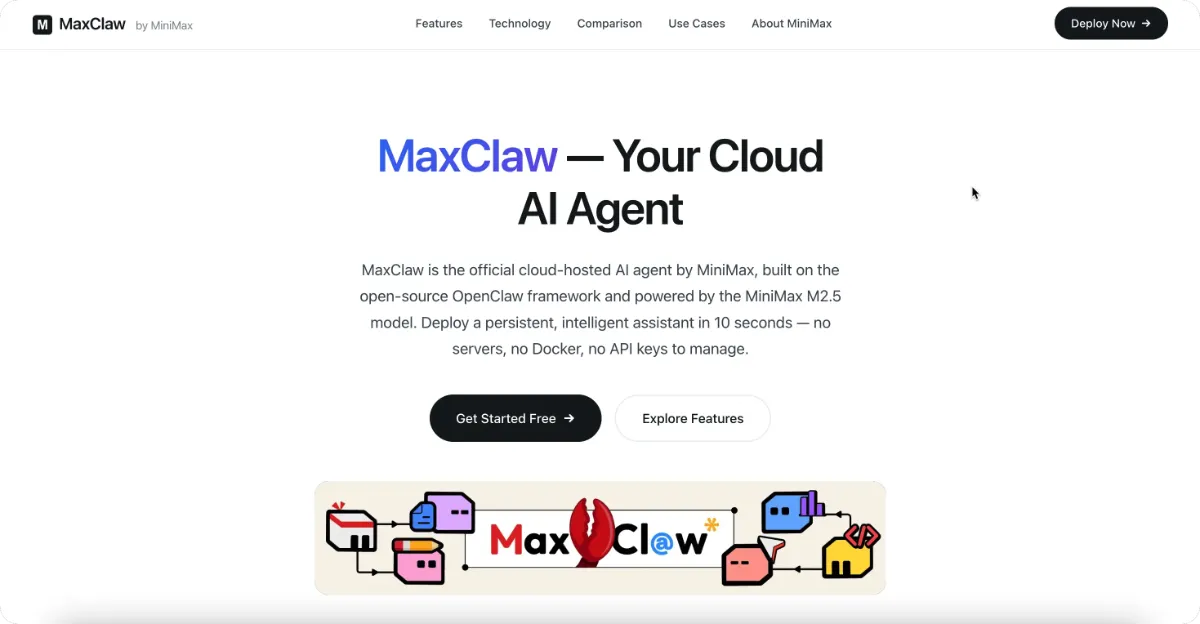
1. One-Click Deployment: The 10-Second Promise
The headline claim on MaxClaw's site sounds like marketing copy: deploy a fully operational AI agent in under 10 seconds. Reviewers who tested it say it actually delivers.
- How it works: Visit agent.minimax.io, select MaxClaw from the navigation bar, and click "Deploy Now." No server selection, no Docker commands, no SSH keys.
- Real-world test: The WaveSpeedAI blog documented their experience: "Ten seconds later, I had a running agent. Not an agent that would run after I configured eight more things. A running agent." (WaveSpeedAI, Feb 2026)
- The catch: There isn't one, for most users. The tradeoff is control — you cannot swap the underlying model or self-host. But for the target audience, that's the point.
Expert Note: Analytics Vidhya confirmed the deployment experience in their beginner's guide: MaxClaw is "easy for non-technical users to set up" while simultaneously serving "as a development platform for creating and automating complex workflows." (Analytics Vidhya, March 2026)
2. The MiniMax M2.5 Engine: Frontier Intelligence at a Fraction of the Cost
MaxClaw is not just a deployment wrapper — the model underneath it is genuinely competitive.
-
Architecture: MiniMax M2.5 uses a Mixture-of-Experts (MoE) design with 229 billion total parameters, but only ~10 billion are activated per token. This sparse activation is what makes it fast and affordable without sacrificing reasoning quality.
-
The cost story: MiniMax claims M2.5 delivers intelligence comparable to Claude 3.5 Sonnet at 1/7 to 1/20 of the cost — a figure that makes high-frequency automation economically viable where it previously wasn't.
-
Community verdict: Product Hunt reviewers noted that MiniMax M2 (the predecessor) "outperforms Gemini 2.5 Pro, Claude Sonnet 4.5, and Qwen3 on several benchmarks" for coding and tool use. (Product Hunt)
-
Lightning Attention: MiniMax's proprietary hybrid attention mechanism eliminates the quadratic scaling bottleneck of standard Transformers, enabling context windows between 200K and 1 million tokens.
3. Persistent Long-Term Memory: The Real Differentiator
Most AI tools are stateless — they forget everything the moment you close the tab. MaxClaw was built around the opposite philosophy.
-
What it does: MaxClaw retains context across days or weeks of interaction, remembers user preferences, and accumulates knowledge from past tasks to improve future outputs — all without manual prompting or database configuration.
-
Token depth: The persistent memory spans over 200,000 tokens, managed entirely in MiniMax's cloud.
-
Why it matters: As MiniMax's press release put it, this transforms MaxClaw "from a single-task executor into a persistent digital collaborator that grows more effective over time." (FinancialContent / 24-7 Press Release, Feb 2026)
-
Compared to alternatives: KimiClaw by Moonshot AI offers 40 GB of cloud storage for document retrieval, but MaxClaw's conversational memory model is better suited for agents that need to adapt to a user rather than simply search through files.
4. Multi-Platform Integration: Your Agent Lives Where You Work
MaxClaw connects directly to Telegram, WhatsApp, Discord, and Slack — no webhook setup, no bot token management beyond an initial 90-second guided flow.
-
Supported channels: Telegram, WhatsApp, Slack, Discord, Feishu, DingTalk.
-
The experience: The WaveSpeedAI reviewer reported that Telegram setup took under 90 seconds — "most of that was waiting for a bot token."
-
Why this matters operationally: Eliminating context switching between an AI tool and a communication platform is a meaningful productivity gain for teams already living in Slack or Discord.
-
Flat pricing: A MiniMax subscription covers all model usage with no separate per-token API charges on top — a cost advantage SaaSCity specifically highlighted for teams running agents at high frequency. (SaaSCity, Feb 2026)
5. The OpenClaw Toolchain: Built-In Capabilities That Actually Work
MaxClaw inherits the full OpenClaw tool ecosystem — and reviewers noted that the tools work together without manual orchestration.
-
Built-in tools include: Web search and real-time research, code execution and generation, file analysis (documents, Excel, PDFs, images, video, audio), image generation, video generation, scheduling and cron jobs, website building, and AI-generated presentations.
-
Multi-step reasoning in practice: One WaveSpeedAI test asked MaxClaw to "check recent discussions about transformer alternatives and summarize the key approaches." The agent searched, pulled content, cross-referenced sources, and returned a structured summary — "no separate tool invocations I had to manage."
-
ClawHub: MaxClaw provides access to MiniMax's Expert ecosystem with 10,000+ ready-made agents, plus the ability to create and publish custom agents for rewards.
-
Known limitation: Early users on X flagged bugs with cron job scheduling at launch. SaaSCity noted this directly: "It's fresh software. Worth knowing going in."
2026 MaxClaw Capability Matrix
| Feature | MaxClaw | Self-Hosted OpenClaw | KimiClaw |
|---|---|---|---|
| Deployment Time | ~10 seconds | Hours (Docker/VPS) | Minutes (browser-based) |
| Long-Term Memory | 200K+ tokens | 1.5 GB+ RAM required | 40 GB file storage |
| Platform Integration | Telegram, WhatsApp, Slack, Discord | Manual webhook setup | Browser-native (kimi.com) |
| Model | MiniMax M2.5 (MoE, 229B params) | Bring Your Own | Kimi K2.5 (1T params) |
| Maintenance Required | None (fully managed) | Ongoing | None (fully managed) |
| Best For | Productivity, messaging-first teams | Full control, privacy-first | Document-heavy, browser workflows |
The Verdict: Who Should Use MaxClaw?
MaxClaw is not the right tool for every use case. If you need to swap foundation models, control exactly where your data lives, or operate under strict data sovereignty requirements (medical records, proprietary code, regulated industries), self-hosting OpenClaw or building on LangChain remains the more defensible choice.
But for the majority of individual users and teams, the calculus is clear. If you spend your day in Slack or Discord, need pre-built agents for coding review, financial reports, or document workflows, and want something running in under a minute — MaxClaw is the path of least resistance in 2026.
Editorial Note: Both MiniMax and Moonshot AI are Chinese companies operating under Chinese data law. For personal productivity workflows, this is likely irrelevant. For teams processing sensitive customer data or proprietary business information, it is a decision worth making explicitly. The Geeky Gadgets review of MaxClaw + MiniMax M2.7 (the model's latest update as of March 2026) confirmed that the core value proposition — "persistent memory, customizable skills, and multiplatform accessibility" — remains intact as the platform matures. (Geeky Gadgets, March 2026)
MaxClaw is available now at maxclaw.ai. Deployment starts at agent.minimax.io.